Professor Imants Barušs
Blog
April 24, 2026. Another academic year
has slipped by. Wait. I just said that. A year ago. I guess one highlight for me
was the Science of Consciousness Conference in July in Barcelona. Literally two
days before I left, Stuart Hameroff, the main organizer of the conference, asked
me to give a talk in the taxonomy workshop in addition to my planned talk about
our cell phone research. I said ok. He didn't give me a time limit, so I ended
up talking for over an hour and, as I did so, the room kept filling up with
people so that by the time I finished, it was crowded with lots of people
standing at the back and in the doorway. I was trying to outline the basics that
everyone needs to know if they are going to try to research consciousness. My
cell phone talk also went well as did my Latvian PhD student's poster. Again, it
felt as though there was a shift in zeitgeist in the air. In one of the plenary
sessions, children were demonstrating extraocular vision --- a blindfolded girl
read off someone's business card and a blindfolded boy solved a Rubik's cube.
The plenary session was recorded and you can watch it here
https://www.youtube.com/watch?v=0BUW7Rys8tw. Interesting
things are happening and there isn't as much resistance to admitting that they
are happening. So, how about that for a synopsis of the past academic year. On
to my summer projects.
December 24, 2025. Recommended reading:
In plain sight: An investigation into UFOs and impossible science
(revised and updated) by Ross Coulthart (HarperCollins, 2023).
November 27, 2025. Just got this movie
about Friedrich Jürgenson from Anabela Cardoso for anyone who is interested:
https://vimeo.com/1133519225/fcd54048fe?share=copy&fl=sv&fe=ci.
November 14, 2025. Recommended reading:
If anyone builds it, everyone dies: Why superhuman AI would kill us all
by Eliezer Yudkowsky & Nate Soares (Little, Brown and Company, 2025).
June 13, 2025. Another academic year
has slipped by so I feel I should give some sort of synopsis of what has
transpired. I taught a graduate directed reading course about spiritual
self-transformation to two students who took it for credit and three others who
participated in the weekly discussions. We read three of my books. It was a good
opportunity to enagage at a deep level with this material. On a different note,
in the lab we've been running cell phone apps whose purpose is to communicate
with the dead with some interesting exchanges between us and whatever is
generating the responses. It feels like trying to get a fusion reactor to kick
over and produce more energy than it consumes. All this work going in but not a
lot coming back. But there are spontaneous cases. We have interviewed 65 people
about their cell phone experiences of communicating with the deceased on their
cell phones and that is interesting. Deep, meaningful, positive experiences. I
am glad that we are looking at them and bringing them to the attention of the
academy. For those of you who want to hear some of these results, I will be
presenting at the Science of Consciousness Conference in Barcelon, Spain, on
July 8, 2025. See you there!
December 18, 2024. At the end of last
August, I started working with a group at Rīga Stradiņs University in Latvia to
develop a graduate program that would expose students to the cutting edge of
postmaterialist research about consciousness. And we did it. The program is
called Toward a New Paradigm: Postmaterialism, Consciousness, and Spiritual
Self-Transformation. It takes place, usually every second Saturday (except for
the summer), during 2025 for a total of 20 lectures by some of the world’s
leading luminaries and up and coming talent. In order to be considered for
acceptance to the program, a person needs to have a Bachelor’s degree in any
subject from a recognized university. You can check it out and apply here:
https://www.rsu.lv/en/events/experimental-research-based-continuing-education-programme-toward-new-paradigm.
December 6, 2024. My very first ever
academic presentation was in 1988 at a meeting of the American Association for
the Study of Mental Imagery at Yale University where I presented some of the
results of my PhD research. The organizer was Roni Beth Tower. She reached out
to me recently and it was fantastic to reconnect with her! So she included me in
a blog she wrote for Psychology Today, which you can read here:
https://www.psychologytoday.com/intl/blog/life-refracted/202411/holidays-and-coping-with-a-beloveds-recent-death.
October 31, 2024. I've been asked to do
a fair number of interviews lately. In fact, I just turned down an interview
with CBC radio for this afternoon. But I'm always happy to help out students, so
here's an interview in our student newspaper. Enjoy!
https://westerngazette.ca/culture/science-or-spirit-this-professor-studies-what-happens-after-death/article_c6b145ee-9793-11ef-9d38-076e0a2319c2.html
June 26, 2024. Recommended reading:
The Coming Wave: Technology, Power, and the 21st Century's Greatest Dilemma
by Mustafa Suleyman (Crown, 2023).
 May 6, 2024.
There were three highlights for me this past academic year. The first was the
publication of Death as an Altered State of Consciousness and being a
finalist for a PROSE award. You work in obscurity for decades and then, one day,
somebody notices that you have done some good work. So that is definitely
appreciated. Second was receiving the Bial Foundation research grant that has
allowed us to study people's experiences of after-death communication with their
cell phones. This has been interesting and fruitful. Third was a recent trip to
Brazil to present two talks and five workshops organized by the Federal
University of Juiz de Fora. It felt as though the zeitgeist is changing.
May 6, 2024.
There were three highlights for me this past academic year. The first was the
publication of Death as an Altered State of Consciousness and being a
finalist for a PROSE award. You work in obscurity for decades and then, one day,
somebody notices that you have done some good work. So that is definitely
appreciated. Second was receiving the Bial Foundation research grant that has
allowed us to study people's experiences of after-death communication with their
cell phones. This has been interesting and fruitful. Third was a recent trip to
Brazil to present two talks and five workshops organized by the Federal
University of Juiz de Fora. It felt as though the zeitgeist is changing.
March 29, 2024.
Death as an altered state of consciousness has been selected as a 2024
PROSE Award Finalist in the Psychology and Applied Social Work category. The
PROSE book awards are granted by the Association of American Publishers to
recognize Professional and Scholarly Excellence in book publishing. From the AAP
web site:
“The PROSE Awards 2024 Finalists and Category Award winners illustrate the
extraordinary depth, breadth and complexity of scholarly authorship
and publishing,” commented Syreeta Swann, AAP’s Chief Operating Officer. “We are
pleased to honor these works, and delighted to report that the standard for
scholarly works has never been higher.” So, I want to thank everyone who
contributed to my book, particularly the staff at APA Books, who put up with my
perfectionism. We knew that we had done a good job, but it is heartening also to
be recognized for doing that.
August 24, 2023. My three thesis
students presented at the SSE meeting this summer. Here's a write-up:
Psychology alumnae made King's proud at US-based conference - King's
University College (uwo.ca)
May 12, 2023. I have done the annual
update of my website. There were three things of note for me this past academic
year: 1. I taught all of my courses online this past academic year. I think I'm
getting better at it and also appreciate online teaching more than I did in the
past. 2. I went through the editing, copyediting, proofreading process for my
new book Death as an Altered State of Consciousness. This is the third
of my books being published by the American Psychological Association, and it is
always a pleasure to work with the editors, designers, and marketing staff at
APA Books. It's turning out to be a really nice book and I think that it will be
useful to many readers. You can see it at the top of the
Books page. The
release date for the paperback edition is July 11, 2023. 3. I applied for, and
received, a research grant of Euro 26,500 over two years from the Bial
Foundation for a project titled "After-Death Communication with Cell Phones."
We're just getting going with that and it is a real blast! I'll let you know if
we find anything interesting.
April 21, 2023. Recommended reading:
Coders: The making of a new tribe and the remaking of the world by
Clive Thompson (Penguin, 2019).
December 16, 2022. One of my students
looked into the aftermath of taking Jeffery Martin's Finder's Course. That paper
has now been published. Here is the doi for it:
https://doi.org/10.1037/cns0000297.
October 26, 2022. Recommended reading:
The psychology of totalitarianism by Mattias Desmet (Chelsea Green
Publishing, 2022).
September 5, 2022. Recommended reading:
The Courage to Face Covid-19 by John Leake and Peter McCullough
(Counterplay Books, 2022).
July 1, 2022. Recommended reading:
Skinwalkers at the Pentagon: An insider’s account of the
secret government UFO program by Lacatski,
Kelleher, & Knapp (RTMA,
2021).
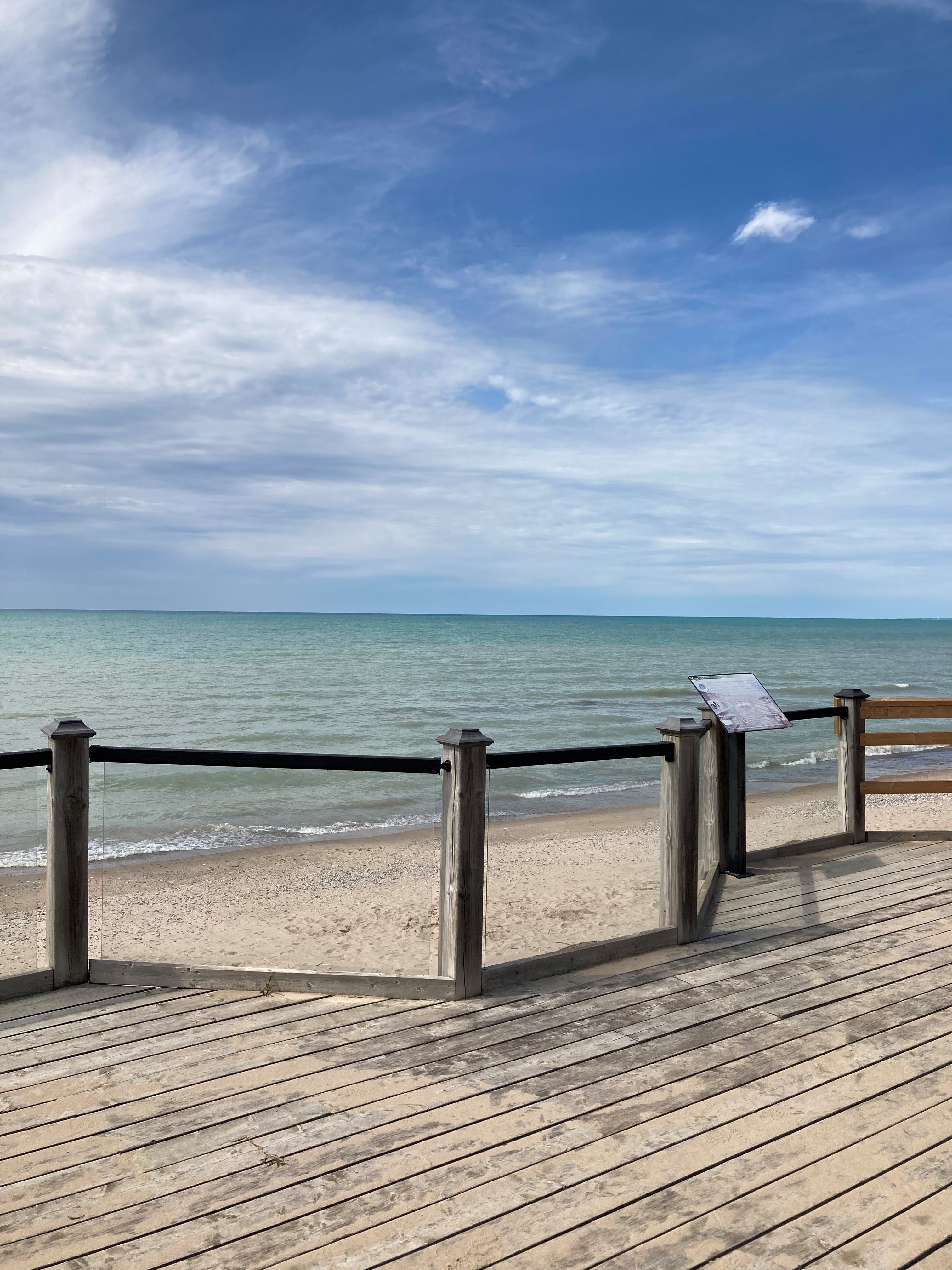
June 21, 2022. Summer solstice.
 May 27, 2022. When people with whom I
haven't spoken for some time ask me what's new, I laugh and remind them that in
the academy things move at glacial speed and that very little has changed. The
fact that I only update this web site once a year in the spring is a testament
to that. But the flip side is that things do actually change over time. I've had
several books and key papers come out in the last several years. And I have just
completed the first draft of my new book about death as an altered state of
consciousness. And my students keep doing fantastic work, along the way, winning
awards, presenting at major conferences, and getting their papers published in
influential journals. So I hope that my annual update of this web site inspires
those of you who are reading this.
May 27, 2022. When people with whom I
haven't spoken for some time ask me what's new, I laugh and remind them that in
the academy things move at glacial speed and that very little has changed. The
fact that I only update this web site once a year in the spring is a testament
to that. But the flip side is that things do actually change over time. I've had
several books and key papers come out in the last several years. And I have just
completed the first draft of my new book about death as an altered state of
consciousness. And my students keep doing fantastic work, along the way, winning
awards, presenting at major conferences, and getting their papers published in
influential journals. So I hope that my annual update of this web site inspires
those of you who are reading this.
March 22, 2022. Recommended reading:
Adjunct professors struggle with low wages, no health benefits
(usatoday.com).
March 17, 2022. I've been on sabbatical
this academic year, writing a book about death. So I wrote a paper about writing
about death. You can read it here:
https://www.scientificexploration.org/edgescience/49.
December 13, 2021. Recommended viewing:
FLCCC Weekly Update Dec. 8, 2021: Profits before Patients? (odysee.com)
October 15, 2021. Recommended reading:
CUP Wire: The story of education in five scams - The Fulcrum.
October 4, 2021. Recommended reading:
‘This is an endemic situation’: The realities of part-time professorship
- The Fulcrum.
September 22, 2021. Recommended
reading: Diary of a Death Doula: 25 Lessons the Dying Teach us about the
Afterlife by Debra Diamond (John Hunt Publishing, 2019).
September 15, 2021. Recommended
viewing:
https://rumble.com/vhp7y5-full-interview-world-renowned-doctor-blows-lid-off-of-covid-vaccine.html.
August 9, 2021. Recommended reading:
Till death don’t us part: A true story of awakening to love after life
by Karen Frances McCarthy (White Crow Books, 2020).
June 21, 2021. Recommended reading:
After: A Doctor Explores what Near-Death Experiences Reveal about Life and
Beyond by Bruce Greyson (St. Martin's Essentials, 2021).
Several years ago, one of my thesis students ran a
random event generator (REG) experiment to see if the mind could directly
influence the REG. Nope. Another student came along and decided to tweak some of
the variables to increase the likelihood of an effect. In particular she (or a
research assistant) led participants through a guided imagery exercise which
included inducing feelings of love. This time there was an effect in the
intended direction. The paper describing those experiments has now been
published and you can read it here:
https://journalofscientificexploration.org/index.php/jse/article/view/1891.
February 19, 2021. Recommended reading:
Cured: The Life-Changing Science of Spontaneous Healing by Jeffrey
Rediger (Flatiron, 2020).
February 9, 2021. Radical
Transformation has been published! You can find it here:
Imprint Academic or at your favourite bookseller. And
King's wrote up a nice press release for it
here. I felt compelled to write the book as part of an
effort to heal planetary crises, so I hope it is useful to you.
December 15, 2020. My new book
Radical Transformation now has a web site:
Imprint Academic.
December 5, 2020. Recommended
documentary: "I am Greta"
Official Trailer (imdb.com).
August 14, 2020. The second edition of
Alterations of Consciousness has now launched! You can see it on the
Books page. Enjoy!
May 20, 2020. I have completed the
annual update of my web site! Most notably, I cleaned up the "Books" page, added
the second edition of Alterations of Consciousness, and added a cover
photo and a title page image for a couple of the older books. I just want to
say, for those of you who are interested in what I have to say, that the older
books are still useful. In particular, for those of you who have not read it,
Chapter 2, Authenticity, from Authentic Knowing is an apposite analysis
of compliance that is as relevant now as it was when I wrote it. I don't have
time to repeat myself, so if you're wondering how I got to have the crazy or
brilliant (or both) ideas that I now have, well, you can read the earlier books
to find out. I also added a page for Psychology 2065a Psychology of Religion and
Spirituality which I am teaching again for the first time in 30 years! Looking
forward to it!
May 7, 2020. I have finished working on
the second edition of Alterations of Consciousness and it is now in
production with a release date of July 28, 2020. You can preorder your
copy
here or from your favourite bookseller. Enjoy!
April 20, 2020. Recommended reading:
https://blogs.scientificamerican.com/observations/the-coronavirus-and-post-traumatic-growth/.
April 6, 2020. Recommended reading:
https://www.amazon.com/dp/1949003582.
November 27, 2019. Resource about
careers in psychology in Canada:
https://ecampusontario.pressbooks.pub/psychologycareers/front-matter/foreword/.
August 8, 2019. The talk I gave last
summer at the annual meeting of the Society for Mathematical Psychology has been
published as a paper in the journal Consciousness with the title
"Categorical Modelling of Conscious States." The paper is open access and you
can read it
here. Enjoy!
October 8, 2018. I've been working on a
theory of meaning fields, extending meaning beyond the human, with the first
paper now published in EdgeScience, Volume 35, which you can read by
clicking
here and scrolling down to page 8.
July 12, 2018. Recommended
reading: How Forests Think: Toward an Anthropology beyond the Human by
Eduardo Kohn (University of California Press, 2013). I read this book several
years ago and am just returning to it to read the sections I highlighted and my
margin notes. I like the way Eduardo feels his way into both the phenomenology
and the scholarship of reaching beyond the human in an effort to understand
representation, thinking, and meaning-making.
June 22, 2018. The Academy
for the Advancement of Postmaterialist Sciences, which I helped to found, is off
to a strong start. Check it out here:
http://www.opensciences.org/blogs/open-sciences-blog/introducing-the-academy-for-the-advancement-of-postmaterialist-sciences
or here: https://www.aapsglobal.com/.
May 17, 2018. Well, I
updated my website today. I do that once a year when classes have ended. The
main difference is on the "research" page where I summarized some of the current
research projects. Several students have remarked that my web site is a bit
"clunky" (my word, not theirs) implying that that were somehow a shortcoming.
But a recent conversation with Charley Tart clarified that such "clunkiness" is
actually beneficial because it helps to focus the reader's attention on the
substance of the content of the website. Are Charley and I just rationalizing?
Whether we are or not is irrelevant since I don't have time to improve the
appearance of the web site anyway. Which reminds me of a comment that I read on
the Internet several years ago by a pundit who complained that I had "no web
presence" or something to that effect, making it sound as though that were a bad
thing somehow. That made me laugh. I am here for those who can find me and need
me. That's it.
February 9, 2018. The
Consciousness Conference is set to go on Saturday, March 3, 2018. Information
about the conference, including a poster and the full program, with abstracts,
can be found at this url: http://baruss.ca/cc.htm.
December 13, 2017. I have
created a web page for the Consciousness Conference, which can be found at this
url: http://baruss.ca/cc.htm.
December 8, 2017. Some
students and I have organized a one-day Consciousness Conference here at King's
for Saturday, March 3, 2018 for anyone who is interested. Here is the
poster for it.
November 3, 2017. I have a
new paper published, titled "Consciousness:Where We Are At," in
Consciousness, the new journal of our Society for Consciousness Studies.
You can read the paper at the following url:
http://www.conscjournal.org/wp-content/uploads/2017/11/CONSCIOUSNESSIB.pdf.
September 4, 2017. Sixteen
of my papers are now open access on Western's server:
http://ir.lib.uwo.ca/do/search/?q=author_lname%3A%22Baru%C5%A1s%22%20AND%20author_fname%3A%22Imants%22&start=0&context=674312&sort=date_desc&facet=.
July 28, 2017. Recommended
reading: The Leap: The Psychology of Spiritual Awakening by Steve
Taylor (New World Library, 2017).
July 27, 2017. Recommended
reading: Why Dissent Matters: Because Some People See Things the Rest of Us
Miss by William Kaplan (McGill-Queen's University Press, 2017).
May 5, 2017. Working on
the annual update of my web site. The biggest change is to the Research Projects
page. I dumped all the language about the old stuff that I had been doing in the
past, which readers can interpolate from the publications list anyway, and
focussed on my currently active projects. I also renamed the page "The
Consciousness Lab" since my collaborators and I have been spending mucho hours
down there. So, to see what we've been up to, just go to the
research page.
August 20, 2016.
Transcendent Mind is currently
#1 New Release in Popular Experimental Psychology on
Amazon.com.
August 15, 2016. My new
book, Transcendent Mind, co-authored with Julia Mossbridge, is released
for sale today. Please see my
books page for more information. Enjoy!
June 15, 2016. My thesis
student, Paula Rayo, received the Department of Psychology Thesis Award during
convocation ceremonies yesterday for her thesis "Surrendering to the
Vine of the Soul: Ayahuasca Shamanism as a Logotherapy." She spent four weeks at
a retreat centre in the Amazon gathering questionnaire and interview data, and
found that participation in ayahuasca ceremonies was correlated with increased
existential meaning.
May 20, 2016. My new book,
co-authored with Julia Mossbridge, titled Transcendent Mind: Rethinking the
Science of Consciousness, published by American Psychological Association
Books has a release date of August 15, 2016 but is now available for pre-order
from the publisher
APA Books, from
Amazon.com, and from
Amazon.ca. Enjoy!
May 2, 2016. Recommended
reading: Living in Denial: Climate Change, Emotions, and Everyday Life
by Kari Marie Norgaard (MIT Press, 2011).
April 27, 2016. Recommended
reading: Subtle Activism: The Inner Dimension of Social and Planetary
Transformation by David Nicol (State University of New York Press, 2015).
March 7, 2016. Recommended
reading: The Man Who Could Fly: St. Joseph of Copertino and the Mystery of
Levitation by Michael Grosso (Rowman & Littlefield, 2016).
January 7, 2016:
Recommended:
https://carlossalvarado.wordpress.com/2016/01/07/paramooc2016-new-series-of-lectures-about-parapsychology/.
June 9, 2015: Recommended
reading: Your Inner Will: Finding Personal Strength in Critical Times
by Piero Ferrucci (Jeremy P. Tarcher, 2014).
March 13, 2015.
Recommended reading: Radical Remission: Surviving Cancer Against All Odds
by Kelly A. Turner (HarperOne, 2014).
December 26, 2014:
Two undergraduate thesis students, a research assistant, and I gathered data at
a Matrix Energetics seminar in Philadelphia on the weekend of August 18 to 20,
2012 as well as on a web site two months after the seminar. We have now
completed analyzing the data and written a final report that has been published
as a paper "Alterations of Consciousness at a Self-Development Seminar: A Matrix
Energetics Seminar Survey" on pages 1064 to 1086 in Volume 5, Number 11 of the
Journal of Consciousness Exploration and Research. There were 97
participants in the study. On the basis of self-report and behavioural measures,
we found that participants appeared to experience reality as being more
plastic than we ordinarily assume it to be while in an attentive, expanded, and
emotionally positive state of being. We were unable to email 10 of the 97
participants with our final report, so if you are one of those participants,
please let me know and I will get the report to you. Also, anyone who could like
a copy of the paper, please send me an email with your mailing address and I
will send you a copy.
August 20, 2014:
Tara MacIsaac included me as one of her eight scientists in her blog post
"8 Scientists Contemplate the Place of Consciousness in Science"
published this morning in Epoch Times.
August 19, 2014:
"I have always tried to maintain my amateur status. . . . I am not even sure
that I comply with my own definition of a good teacher: he learned much, he
taught more. Of one thing I am certain: a good teacher can only have dissident
pupils, and in this repsect I may have done some good." --- Erwin Chargaff, p.
7, A Fever of Reason (The Rockefeller University Press, New York, 1978)
August 15, 2014: My talk at the
Society for Consciousness Studies, titled "A Vision for the Society for
Consciousness Studies," has been published as a Guest Editorial in Volume 5,
Issue 6 of the Journal of Consciousness Exploration and Research. Anyone who would like
to read the paper but cannot access the journal can e-mail me at baruss@uwo.ca.
June 23, 2014: A short paper
based on my talk "Questions about Interacting with Invisible Intelligences" has
now been published in
EdgeScience. Also, an edited part of the paper I gave last summer at the
Franklin Wolff conference has been reprinted in
Hypnology: The Journal of Hypnosis and Consciousness Research. Also, I gave
a talk, titled "A Vision for the Society for Consciousness Studies" at the
inaugural meeting of the Society for Consciousness Studies at the California
Institute of Integral Studies on May 31, 2014. I have submitted the paper for
consideration for publication and will post a note here if the paper is accepted
for publication.
April 25, 2014: One of my thesis students, Vanille Rabier,
wanted to see if she could replicate Daryl Bem's retrocausal recall experiments
in which participants exposed to a list of words practice a random selection of
those words after doing a free recall task. The idea is to see whether the later
practice affects the recall task. We did not find an effect. That was published
as an article: "Failure to Replicate Retrocausal Recall" in the new American
Psychological Association journal Psychology of Consciousness. The
full
reference is given on the publications page. On March 21, 2014, I gave
a talk titled "Questions about Interacting with Invisible Intelligences" at the
sixth Exploring the Extraordinary Conference held at Gettysburg College in
Pennsylvania. For those who are interested, the substance of that talk will show
up in future papers and books. Please note that I am on sabbatical for this
coming academic year and will not be teaching or supervising undergraduate
student theses.
October 11, 2013: I was invited to give the keynote talk
at the 2013 Franklin Merrell-Wolff Conference at the Great Space Center in Lone
Pine California on August 10, 2013. My talk was titled "Learning to Forget:
Reflections on Self-Transformation." That talk has now been published with the
title "Learning to Forget: Deprogramming as a Precondition for the Occurrence of
Non-Dual States of Consciousness" in the Journal of Consciousness Exploration
and Research. To read it click on the following link:
http://jcer.com/index.php/jcj/article/view/326/352.
August 5, 2013: A logic paper written together with
Robert Woodrow titled "A Reduction Theorem for the Kripke-Joyal Semantics" has
been published online in the journal Logica Universalis. I will have
offprints available once the print version of the journal hits the stands for
anyone who would like one.
May 8, 2013: My new book is out! I have put some
information about it on my
books
page. I like the finished product.
January 1, 2013: Just a couple of news items. The
Russian-language version of my paper "What We Can Learn about Consciousness from
Altered States of Consciousness" has been published with the title
"On the Study of Consciousness" in Existentia:
psihologija i psihoterapija, Volume 5, pages 88 to 113. Carlos Alvarado mentioned
the English-language version of that paper in a recent blog
http://carlossalvarado.edublogs.org/2012/11/26/imants-baruss-on-altered-states-of-consciousness/. And John Hunt has announced a launch date of March 29, 2013 for
my new book:
http://www.iff-books.com/books/when-impossible-happens. He is publishing it
under his science, philosophy, and law imprint, Iff Books. It is already
available for pre-order from Amazon.com and Amazon.co.uk at a reasonable price.
Professor Gary Schwartz had this to say about the new book: "Sometimes the most
convincing and meaningful data come not from the university laboratory but from
the laboratory of personal life. Dr. Imants Baruss practices the integration of
academic and self-science in an inspiring and compelling manner. This book
stunningly illustrates how the trained scientific mind can help reveal the
seemingly impossible in everyday life."
August 2, 2012: I was invited to give a talk on April 28,
2012 at the California Cognitive Science Conference at the University of
California Berkeley. That talk titled "What We Can Learn about Consciousness
from Altered States of Consciousness" has now been published in the Journal
of Consciousness Exploration and Research and can be read at:
http://www.jcer.com/index.php/jcj/article/view/227. The paper is also being
translated into Russian and will appear in the Russian-language journal
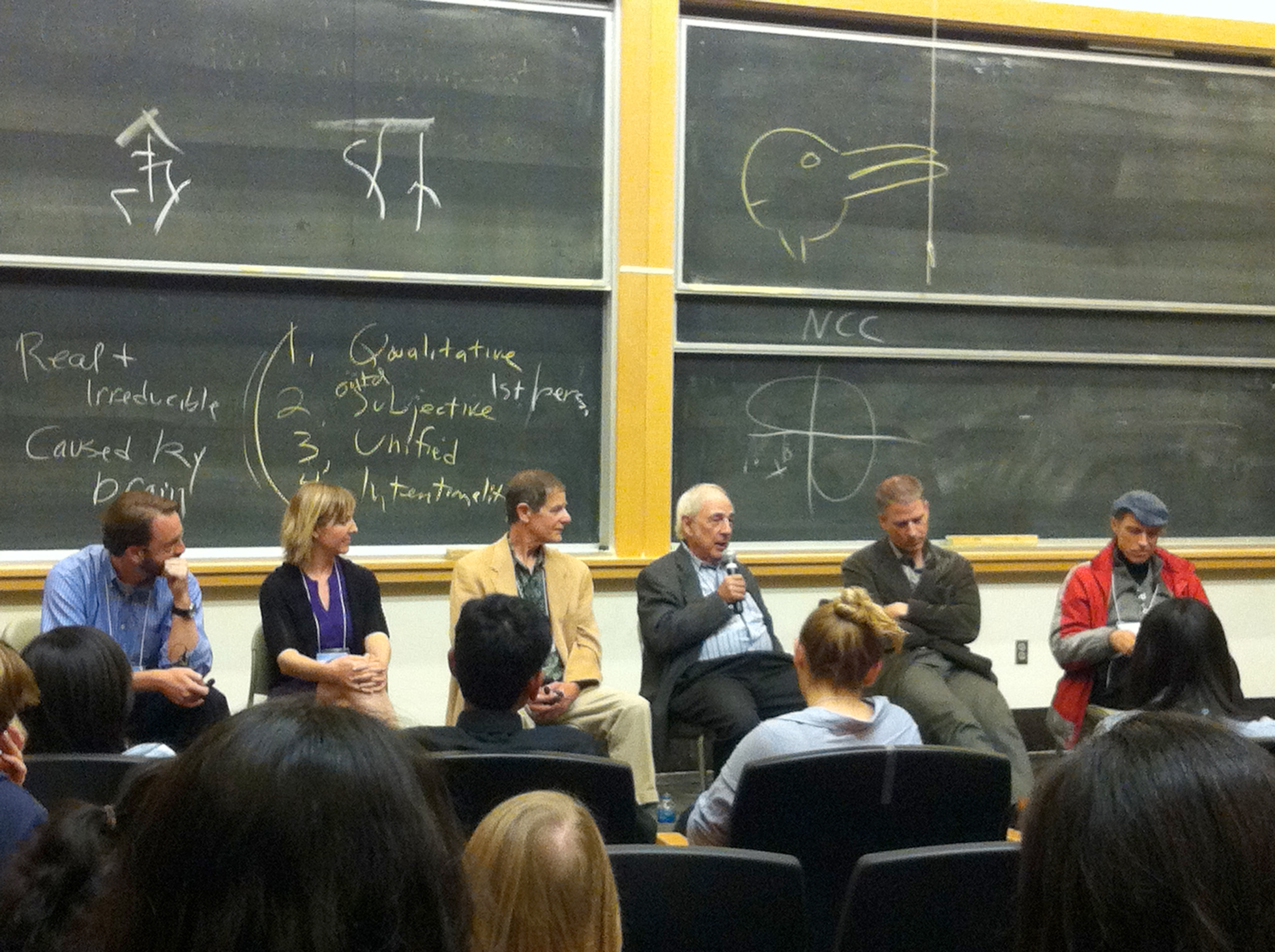
Existentia: psihologija i psihoterapija. Here's a photo from the debate with
John Searle holding the microphone (those are his notes on the chalkboard) and
Christof Koch between Professor Searle and myself.
© 2015-21 Imants Barušs